Staying safe out there
Health & safety
Remote medical access, emergency communications, and the everyday hazards worth actually planning for.
Medical access in remote areas
The Royal Flying Doctor Service (RFDS) provides emergency aeromedical retrieval and remote clinics across the outback — it's the reason a serious medical event in genuinely remote country is survivable rather than catastrophic. Know that it exists, and know that dialling 000 is still the right first step in any emergency, remote or not; the operator coordinates RFDS involvement where needed.
If you manage an ongoing condition, carry a written summary of medications and dosages, and enough supply to cover unexpected delays — remote pharmacies are scarce and often can't fill unfamiliar prescriptions on short notice.
Emergency communications
- UHF radio is the standard for vehicle-to-vehicle communication and general road-trains-and-truckies etiquette on remote highways — channel 40 is the common trucker/highway channel to monitor.
- A satellite phone or PLB (Personal Locator Beacon) is genuinely worth carrying on any route without reliable mobile coverage — the Gibb River Road, Cape York and much of the Red Centre included. A PLB is a one-off purchase, no subscription, and is registered free with AMSA (Australian Maritime Safety Authority).
- Tell someone your route on any remote leg — a rough itinerary and expected check-in time with a family member costs nothing and matters if something goes wrong off-grid.
Dangerous wildlife
Saltwater crocodiles are present in waterways across northern Australia (roughly north of Rockhampton on the east coast, and the entire Kimberley/Top End coastline) — never swim or stand at the water's edge in croc country unless a sign explicitly says it's safe. Snakes are common but rarely aggressive; wear closed shoes walking through long grass and give any snake space rather than approaching it.
Fire, flood and cyclone season
Check the Bureau of Meteorology (bom.gov.au) and your state's fire authority before entering an area under a fire ban, flood watch or cyclone warning — conditions can change faster than a loose itinerary accounts for. See Seasons & Regions for the broader seasonal picture.
Road safety on long hauls
- Fatigue is a genuine risk on long, straight outback highways — stop every two hours, and don't push through drowsiness to reach a destination.
- Wildlife at dawn and dusk is one of the most common causes of vehicle damage on rural roads — kangaroos, wallabies and wombats move most in those hours. Many experienced lappers simply avoid driving between dusk and dawn outside towns.
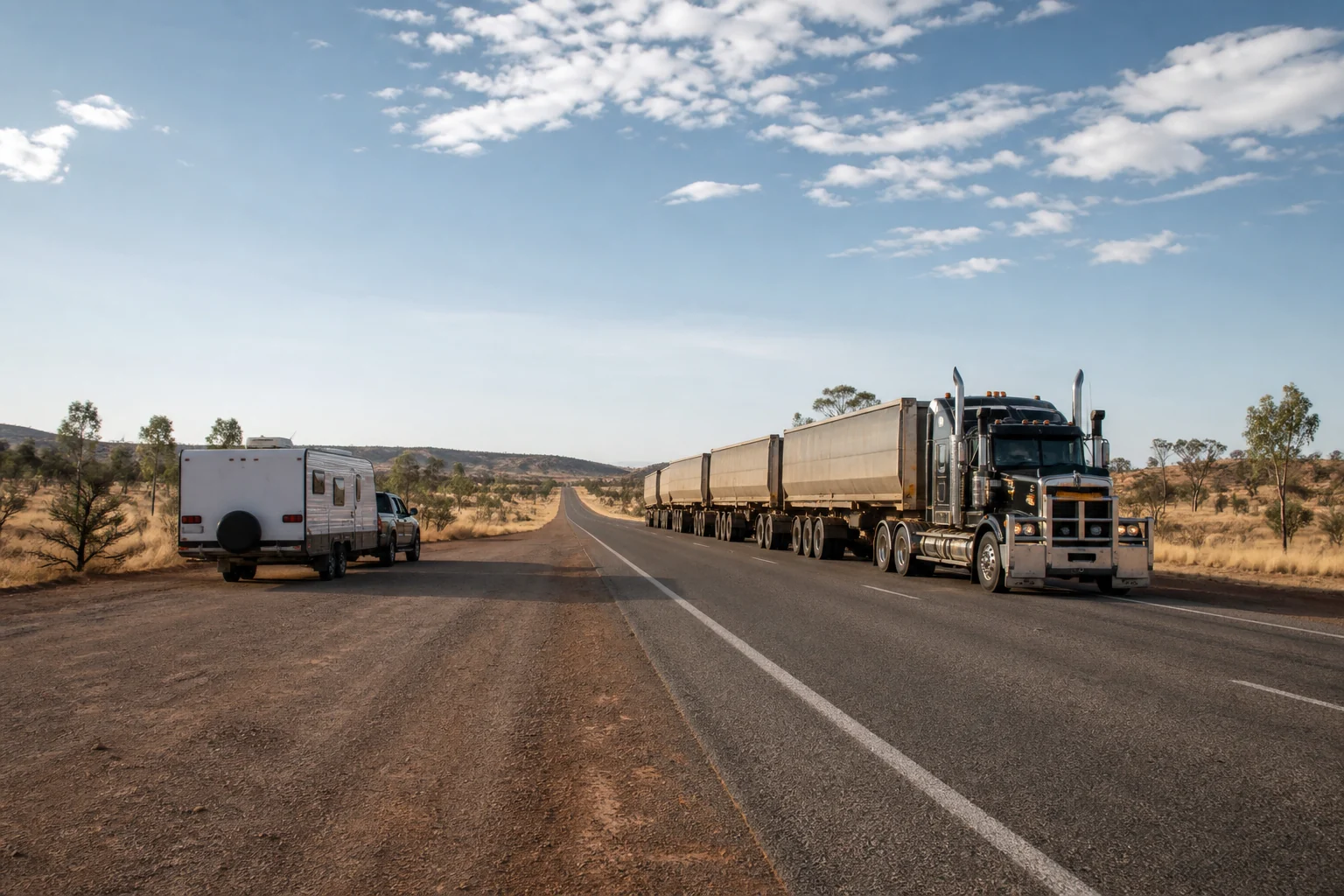
- Road trains can run over 50 metres long on outback highways — give them a very wide berth when overtaking, and never attempt to overtake near a bend or crest.
Building a basic remote first-aid kit
A standard car first-aid kit isn't really built for the distances involved in remote travel, where help can genuinely be hours away rather than minutes. Worth adding beyond the basics: a snake bite bandage (and knowing the pressure-immobilisation technique before you need it, not while you're using it), rehydration sachets for heat-related illness, a thermometer, and enough of any regular prescription medication to cover a delay of a week or more if a remote leg runs longer than planned. A short first-aid course before departure is one of the more practical things a first-time lapper can do — St John Ambulance runs them regularly in most capital cities.
Getting a second opinion on a risky leg
If a specific leg of your route worries you — a remote crossing, a stretch with patchy coverage, timing that's tight against the season — a Route Season-Check or a planning call is a cheap way to have someone who's done it check your plan before you're the one relying on it. See Services & Pricing for the full list.
Free account, real perks
Save your emergency contacts and route plan to your free account
- Save routes, camps and gear notes — pick them back up from any device
- 10% off every paid planning service on this site
- A free Route Season-Check (normally AU$59) the first time you save a route